

Pruning Hope
an advent poem

It’s been a while … not only since I’ve posted here but since I’ve written anything.
I know, I know—a while is subjective. So, some dates:
My last post was October 11. I posted only twice in the summer, and my final post of spring was titled “Contemplating a Dry Season.” But honestly, I didn’t expect the inspirational drought to last so long.
Eight posts in January became six posts in February, four posts in March, two in April. It’s like the words have been dwindling.
And yes, I did quite a bit of writing over the summer—trying to finish that trilogy I’ve been working on for five+ years (and that I was ready to scrap by the end of August).
But I haven’t touched that WIP since the end of September.
It’s like the words have been dwindling.
It’s the Advent season … a season I didn’t grow up with, but I’ve come to appreciate seasons and cycles. They offer a sort of comfort, an expectation perhaps that things will not always be one way. That things come to pass, and that some things will come again. Kind of like hope, which is the focus of Advent’s first week.
Hope, mingled with waiting—the overall theme of Advent.
I woke early this morning. Well, Bob the cat woke me early this morning. At 2:00 am, it was Beluga the cat. At 4:00 am, it was Naiti the cat. (And yes, one considers their life choices at such moments in the night—specifically, their choice to open their home to so many cats.)
At 6:30, it was the Bob-cat. As good a time as any to get up.


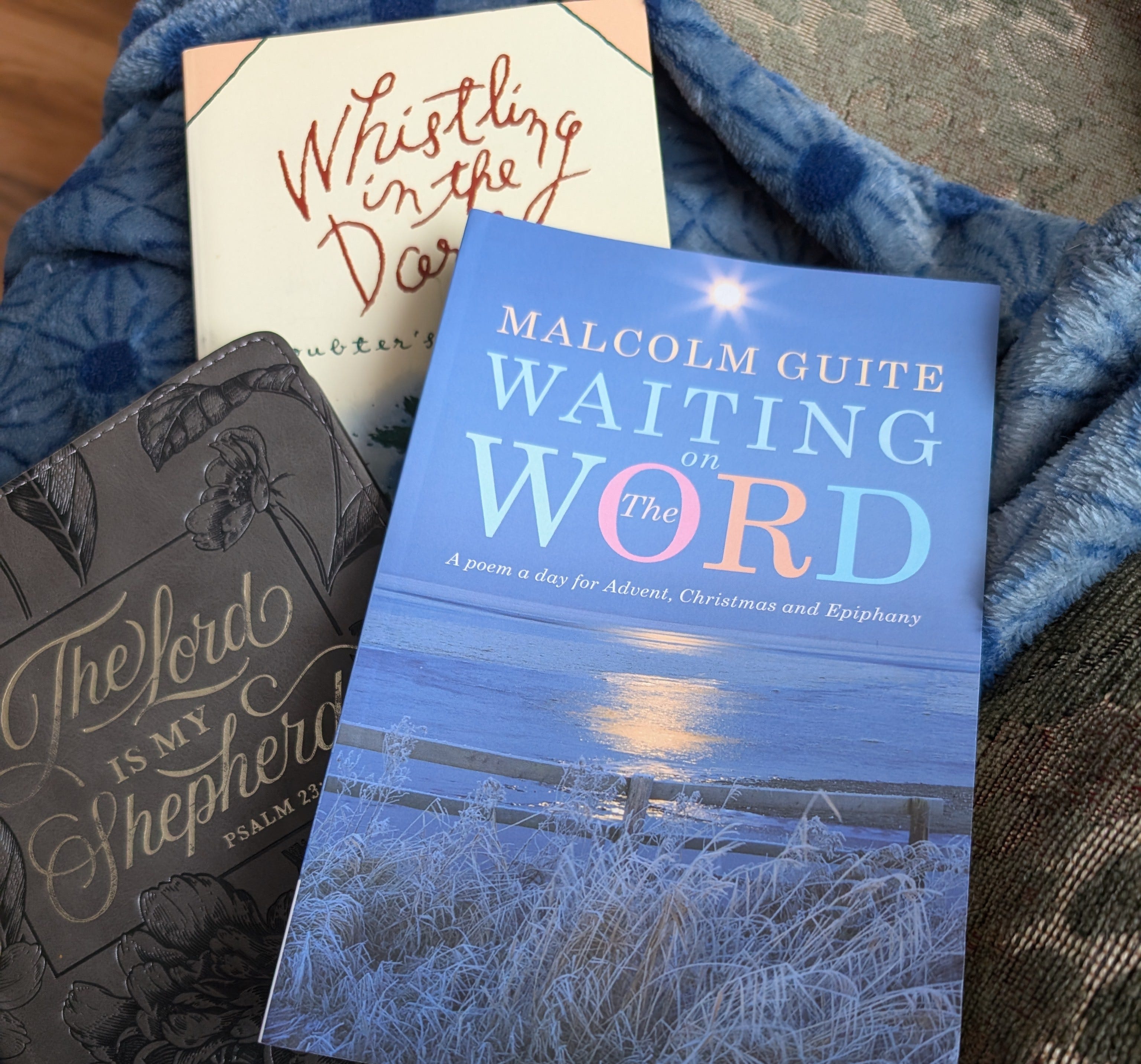
I’ve been reading a couple of Advent books this past week: God is in the Manger, collected writings of Dietrich Bonhoeffer (who knew something about waiting), and Waiting on the Word by Malcolm Guite.
This morning, I also found a short piece about Advent from a book I randomly pulled from my “favorites” shelf this morning: Whistling in the Dark by Frederick Buechner:
“In the silence of a midwinter dusk there is far off in the deeps of it somewhere a sound so faint that for all you can tell it may be only the sound of the silence itself. You hold your breath to listen.
You walk up the steps to the front door. The empty windows on either side of it tell you nothing, or almost nothing. For a second you catch a whiff in the air of some fragrance that reminds you of a place you’ve never been and a time you have no words for. You are aware of the beating of your heart.
The extraordinary thing that is about to happen is matched only by the extraordinary moment just before it happens. Advent is the name of that moment.
The Salvation Army Santa Claus clangs his bell. The sidewalks are so crowded you can hardly move. Exhaust fumes are the chief fragrance in the air, and everybody is as bundled up against any sense of what all the fuss is really about as they are bundled up against the windchill factor.
But if you concentrate just for an instant, far off in the deeps of you somewhere you can feel the beating of your heart. For all its madness and lostness, not to mention your own, you can hear the world itself holding its breath.”
I know a few people who consider Buechner a little too wordy. His sentences could be trimmed, perhaps. But the cadence of that voice, even the longer sentences and the repetition, feel necessary somehow. Like something would be lost if it wasn’t there.
And this morning, in the relative quiet (there might have been several cats around), the readings moved me to writing.
For days, I’d been circling around that theme of hope mingled with waiting.
So finally, I took up a pen and tried to form some of those circling thoughts, half-formed, into something more cohesive:
I wondered at the elements of hope—
what strange bright or shadowed things combine,
if colors, white perhaps, that of snow fresh-fallen
cold as death obscuring broken things beneath
brushing land’s canvas new, if only for a moment,
or green—those shoots spearing past a cold earth
weather-hardened yet giving way the slightest measure
to let life slip through. What elements of hope—
a rope stretched tight to measure time
and its fullness or lack thereof, a dove winging over waters shed
across the whole earth, spying at long last that curled sprig
of green.
Hope, unfurling spaces between sorrow
and joy, nestled in the shadowed corner of a box or heart
or buried seed, blending that sharp edge of borders, quietly
working within stone, hidden yet never completely lost.
It felt a little too long, and I felt the need to prune it.
So, here’s the next iteration:
I wondered at hope—strange,
bright,
snow fresh-fallen,
broken things beneath,
land’s canvas new
or shoots
spearing the cold earth.
Hope – a rope to measure
the fullness of time
a dove winging over
waters
at long last, curled
Hope between sorrow and joy, nestled
in the shadow of a box or heart or buried
seed, blending borders, stone.
And then finally, trimmed to just a few lines:
Hope –
snow fresh-fallen
canvas new
the fullness of time
a dove
sorrow and joy
a heart-buried seed
Each version has kind of a different focus, although the theme of them all is the same. I wouldn’t necessarily say the shortest one is the “finished” version. I like the meandering (perhaps over-wordiness) of the first one in a way.
But I like the shorter ones also … how they hint at meaning between the spaces and allow some breathing room.
December. It tends to be a busy month, perhaps the busiest.
Trying to reach goals set at the beginning of the year before the year is over. Trying to get together with friends and family, some of whom you haven’t met up with all year. Holiday parties and gatherings, shopping and gift wrapping, cleaning and baking. Not to mention planning the new year, contemplating goals and strategies in order to hit the ground running in 2026.
And yet there’s something about December that invites a sort of longing—for quietness, for sitting in the relative peace of a Christmas tree or candlelight or a crackling fire and reflecting, contemplating, hoping.
Waiting. For what exactly, I think even the very most theologically settled or intellectually determined might not quite have words for at such a time.
Advent. In the silence, pausing for a moment to catch the breath, feel the lump in the throat, wonder if the world is itself waiting for something. Wonder if there is something deeper than words and weightier than stars in that phrase
“the fullness of time”
– something that stretches between spring and winter, between the white and the green, between life and death and life again.
Such a small word we have for it, at least for now.
hope
A word that bears, in its way, the world.
absolutely lovely!